
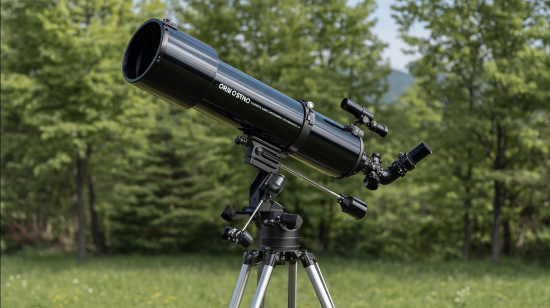
The Telescope That Navigates With You
There is a particular kind of frustration familiar to every intermediate amateur astronomer: you have studied the charts, memorized the coordinates, and carried your equipment out to a hard-won dark-sky site — only to spend the next 45 minutes sweeping the eyepiece across what appears to be a featureless stretch of black, searching for a galaxy that should, mathematically, be right there. The Orion SkyQuest XT8i IntelliScope was built to eliminate that frustration entirely, and it does so without sacrificing the hands-on spirit that makes Dobsonian observing one of the most rewarding formats in amateur astronomy.
At its core, this is a 203mm f/5.9 parabolic Newtonian reflector on a classic Dobsonian rockerbox — a format that has been proven across decades of community use as one of the most efficient aperture-per-euro instruments available. What transforms it into something distinct is the built-in IntelliScope digital computer system, which houses a permanently stored database of over 14,000 celestial objects and communicates with precision shaft encoders on both axes of the mount. Select any target from the database, follow the two directional arrows on the illuminated display, push the tube by hand, and when the readout zeros out — your object is in the eyepiece field. No motors. No external power supply. No noise. Just light, glass, and intelligent guidance.
Named a “Hot Product of Sky & Telescope 2004” and still regularly cited in forum discussions across Cloudy Nights and the wider astronomy community as a benchmark push-to instrument, the XT8i has earned a reputation that outlasts its original production cycle. This review covers everything a prospective buyer needs to know: the optical specifications in depth, the mechanics of the IntelliScope system, build quality, included accessories, and the practical question of who this telescope is genuinely best suited for.
Most Popular Products in This Category
The telescopes below represent the five most frequently purchased and highest-rated instruments among buyers who consider the XT8i — products that share a customer base and are consistently recommended across skill levels as benchmark choices in the Dobsonian and computer-assisted telescope segment.
1. Orion SkyQuest XT8 Classic Dobsonian

The non-computerized sibling of the XT8i and one of the best-selling entry-level Dobsonians of all time, the XT8 Classic features the same 203mm parabolic primary mirror and 1200mm focal length. It delivers exceptional visual performance on planets, globular clusters, and bright galaxies, and is the ideal choice for observers who prefer traditional star-hopping techniques and want the purest aperture-per-euro value without any electronic systems.
⭐⭐⭐⭐⭐ Rating: 4.6 / 5
Price Range: €649 – €799
2. Orion SkyQuest XT10i IntelliScope Dobsonian

The natural step-up from the XT8i, the XT10i offers a 254mm (10-inch) aperture for noticeably deeper reach into low-surface-brightness galaxies, faint planetary nebulae, and densely packed globular clusters. It shares the identical IntelliScope computer interface and push-to operating philosophy, making it the obvious progression for observers who have mastered 8 inches of aperture and are ready to push further into the faint sky.
⭐⭐⭐⭐⭐ Rating: 4.7 / 5
Price Range: €1,299 – €1,599
3. Orion StarSeeker IV 150mm GoTo Reflector

A fully motorized GoTo reflector on a computerized alt-azimuth mount, the StarSeeker IV is designed for observers who prefer hands-free automation over the push-to approach. Its 150mm mirror handles planetary and bright deep-sky targets well, while the SynScan GoTo controller accesses a database of over 42,000 objects. A strong choice for those who prioritize automated convenience and guided tours of the sky.
⭐⭐⭐⭐ Rating: 4.2 / 5
Price Range: €499 – €649
4. Skywatcher Dobson 8″ FlexTube 200/1200

The collapsible FlexTube truss design makes this 8-inch Dobsonian significantly more portable than the traditional solid-tube format. The tube structure collapses to approximately half its assembled length, fitting comfortably into smaller vehicles and tighter storage situations — without any compromise to aperture or optical quality. A popular choice among observers who need serious aperture in a more packable format.
⭐⭐⭐⭐ Rating: 4.3 / 5
Price Range: €749 – €949
5. Celestron NexStar 8SE Schmidt-Cassegrain

A premium 203mm Schmidt-Cassegrain telescope on a motorized single-arm GoTo alt-azimuth mount, the NexStar 8SE delivers the same aperture as the XT8i in a dramatically more compact form thanks to the folded optical path. Its fully automated SkyAlign GoTo system, extensive computerized database, and build quality make it a flagship recommendation for observers who want automation, aperture, and portability in a single premium package.
⭐⭐⭐⭐⭐ Rating: 4.5 / 5
Price Range: €1,499 – €1,899
The IntelliScope Philosophy: Push-To vs. GoTo
Understanding what makes the XT8i genuinely different from the crowded GoTo telescope market requires a clear distinction between two fundamentally different approaches to computerized object-finding. A GoTo telescope uses motorized drives to physically slew the optical tube to its target — the mount does the physical work, and the observer simply waits. This is convenient on paper, but it carries substantial trade-offs: motorized mounts are heavier, significantly more expensive, power-hungry, mechanically complex, and audible in a way that disrupts the quiet atmosphere of a dark-sky site.
The IntelliScope system is a Push-To architecture. There are no motors. Instead, precision digital shaft encoders are mounted on both the altitude and azimuth axes of the Dobsonian rockerbox, reading the telescope’s angular position in real time with high angular resolution. When the observer selects a target from the onboard database, the handheld controller displays two arrow indicators — one for altitude, one for azimuth — along with a numeric distance readout indicating exactly how far and in which direction the tube needs to move. The observer pushes the scope by hand. When both arrows center and the distance reads zero, the object is in the field.
This design philosophy yields practical advantages that go beyond price and weight. Battery consumption is minimal — encoders and a small LCD draw a fraction of the power that servo motors require, meaning standard batteries comfortably last through multiple full nights of observing. The system is completely silent, which matters more than casual observers might expect: the low rumble of motorized slewing is genuinely intrusive at communal dark-sky sites and disrupts the contemplative rhythm of deep-sky observing. Perhaps most importantly, the push-to format keeps the observer physically engaged with the telescope — you learn the spatial relationships between sky regions over time rather than passively watching a motor do the work. The sky becomes familiar. That familiarity, for most observers, is a meaningful part of the reward.
Optical Performance: The 203mm Parabolic Primary Mirror
The optical heart of the XT8i is its 203mm diffraction-limited parabolic primary mirror, ground from soda-lime plate glass and coated for high reflectivity. The 1200mm focal length produces a focal ratio of f/5.9 — a moderately fast system that works effectively across a wide range of eyepiece focal lengths, providing a satisfying balance between wide-field deep-sky sweeping at low magnification and high-magnification planetary work.
The angular resolution limit of 0.57 arc seconds gives this mirror genuine capability on demanding targets: splitting close double stars, resolving fine lunar surface detail along the terminator, and detecting disc features on solar system planets including the Cassini Division in Saturn’s rings, latitudinal cloud banding on Jupiter, and Martian polar caps during favorable opposition. The limiting stellar magnitude of 14.2 opens access to thousands of objects in the NGC and IC catalogs that are completely invisible to smaller instruments — faint galaxy groups, low-surface-brightness ellipticals, delicate planetary nebulae, and extended reflection nebulosity in molecular cloud complexes.
The secondary mirror carries a 47mm minor-axis diameter, producing 23% linear obstruction — a well-controlled figure for a fast Newtonian of this aperture class. Central obstruction at this level has a negligible practical impact on contrast in visual observing; the marginal theoretical loss is far outweighed by the aperture advantage of 8 inches compared to any smaller telescope. The fully blackened interior of the tube suppresses stray light and internal reflections effectively, preserving the contrast that makes low-surface-brightness objects visible against the sky background.
One detail that distinguishes the offering from Teleskop-Spezialisten specifically is their commitment to pre-delivery collimation and inspection on every unit. For a Newtonian reflector, collimation quality is not a minor issue — a mirror that is out of alignment by even a small angular amount can produce significantly degraded images, particularly at higher magnification. Receiving a pre-aligned instrument means that first-light performance is genuinely representative of the mirror’s optical capability, rather than a test of the buyer’s collimation skill.
The Focuser, Eyepieces, and Finder
The XT8i is fitted with a 2-inch Crayford focuser incorporating a 1.25-inch reduction sleeve — a specification that matters considerably for long-term accessory flexibility. The Crayford mechanism uses a smooth roller-and-drawtube design rather than a rack-and-pinion, reducing image shift during the focusing stroke and providing a more refined tactile response for precise critical focus acquisition. The adjustable altitude friction control on the rockerbox allows the observer to fine-tune the vertical bearing tension to compensate for heavier eyepieces, preventing the tube from nose-diving between observations.
The included Sirius Plössl eyepiece set — 25mm and 10mm focal lengths — represents a functional starting configuration. The 25mm delivers 48× magnification with approximately a 1° true field, ideal for initial target acquisition and wide-field deep-sky objects. The 10mm steps up to 120×, appropriate for planetary detail, lunar surface examination, and globular cluster resolution. Both eyepieces perform competently at their respective tasks, though most intermediate observers will eventually want to supplement with a quality 2-inch wide-field eyepiece for maximum deep-sky field coverage and a short-focal-length unit in the 5–6mm range for high-magnification planetary sessions.
The 8×50 right-angle finder scope is a genuine highlight in the included accessories. A 50mm aperture finder is substantively more capable than the smaller 6×30 units often bundled with entry-level instruments — its light grasp is sufficient to show faint stars used as alignment references clearly, and the 8× magnification provides a narrow enough field to make precise centering of alignment stars reliable even in moderately light-polluted skies.
The IntelliScope Computer: Database and Operation
The IntelliScope handheld controller is a self-contained, battery-powered unit that requires no complex initial programming. The only setup step before each session is a 2-star alignment procedure that takes approximately 2–3 minutes: the observer centers two relatively bright, widely separated stars in the eyepiece, confirming each to the computer. The controller uses the encoder readings at those two positions to mathematically model the telescope’s precise orientation relative to the celestial sphere. Once aligned, every object in the 14,000-entry database is accessible with directional confidence for the remainder of the session.
The database is organized across several distinct catalogs. The 837 stellar entries cover double stars and variable stars, with the latter enabling the XT8i to function as a productive variable-star monitoring instrument. The 8 planetary entries include current positional data, making planet-finding trivially fast. The 101 Messier objects form the classic foundation of any deep-sky observing program — every Messier marathon participant benefits from the push-to guidance the IntelliScope provides. The 7,840 NGC objects span the full range of galaxy, nebula, and cluster content from the New General Catalogue, covering most serious visual deep-sky targets. The 5,386 IC objects from the Index Catalogue extend coverage into genuinely faint territory — many IC galaxies and nebulae are rarely attempted without computerized guidance simply because finding them by star-hopping alone is prohibitively time-consuming. Finally, 99 user-defined object slots allow the observer to enter custom coordinates, enabling pursuit of recently discovered comets, specific asteroid positions, or any target not covered by the standard catalogs.
The controller’s illuminated buttons and high-contrast display are well-suited to use under red-light conditions, preserving dark adaptation during extended observing sessions. Navigation is intuitive: select a catalog, choose an object, press enter, and follow the arrows. The display simultaneously shows the directional readout and the angular distance remaining to the target, giving a clear sense of how close the telescope is to being on-point throughout the slew.
Mechanics and Structural Build
The Dobsonian rockerbox that forms the mount of the XT8i is built on the ground-board-and-rocker architecture that has defined the Dobsonian format since John Dobson’s original designs in the 1960s — a configuration that remains unmatched for stability-to-simplicity ratio at this aperture class. The horizontal bearing surface uses a combination of Teflon pads bearing against a laminated ground board to produce motion that is smooth, consistent, and free of the stick-slip behavior that compromises manual tracking quality in lower-quality designs. The azimuth movement is light enough to track objects by hand at moderate and high magnification without introducing vibration, yet damped enough to hold position precisely between adjustments.
The solid optical tube, as opposed to a collapsible truss structure, offers a sealed optical path that is more resistant to dew accumulation on the primary mirror and less sensitive to ambient stray light from surrounding sources. The trade-off is a longer transport length, but for the large majority of observers using this telescope from a vehicle, that constraint is practical rather than prohibitive. The tube interior’s clean blackout treatment is applied consistently, suppressing internal reflections that would otherwise reduce the contrast of extended low-surface-brightness objects.
Community Reception and Observing Legacy
The recognition as a “Hot Product of Sky & Telescope 2004” is more than a historical marketing point. Sky & Telescope’s product evaluations of that period were conducted by experienced amateur observers with hands-on access to a broad competitive field, and the endorsement reflected a genuine consensus that the XT8i represented a meaningful and well-executed advancement in accessible push-to observing technology. In the two decades since, the instrument has accumulated an extensive observing legacy across the global amateur astronomy community — consistently recommended on specialist forums, regularly cited in equipment comparison discussions, and listed in first-telescope shortlists by astronomy societies in multiple countries.
What the community consistently identifies as the XT8i’s distinguishing strength is the quality of the balance it strikes between optical seriousness and operational accessibility. A large-aperture Dobsonian without any guidance system rewards patient, experienced observers with beautiful imagery — but it places an enormous burden on the beginner or intermediate observer who has not yet internalized the sky’s geography. The IntelliScope system removes the highest obstacle to productive deep-sky observing without reducing the observer to a passive spectator. The physical act of moving the telescope, aligning to stars, selecting targets, and refining focus remains intact. The computer is a navigation partner, not a substitute for engagement with the sky.
Who Is the Orion SkyQuest XT8i IntelliScope For?
The XT8i is excellently matched to a specific and clearly defined observer profile: the intermediate amateur who has moved beyond the initial phase of planetary and bright-object viewing and is ready for an instrument capable of supporting years of systematic deep-sky observing. The combination of 8-inch aperture, push-to guidance, and a database spanning virtually the entire visual sky makes observing programs — Messier marathons, galaxy-group surveys, double-star observation projects, variable-star monitoring campaigns — not merely theoretically possible but practically achievable in a single dark night.
It is equally well-suited to the observer who values field portability and battery independence. Unlike GoTo instruments of comparable aperture, the XT8i operates comfortably from a remote site on standard batteries — no external power supply, no inverter, no cable management across a dark field. Setup time from the vehicle to first-light is measured in minutes rather than the extended polar-alignment and motor-calibration procedures required by equatorial GoTo systems.
The listed price of €1,099 including 19% VAT from Teleskop-Spezialisten includes the full IntelliScope controller, 8×50 finder scope, two Sirius Plössl eyepieces, and the assurance of pre-delivery collimation and professional inspection. For an observer ready to invest in a serious optical instrument with a proven observing pedigree, this represents a coherent and well-supported package that will remain relevant and capable long after the initial investment.
Final Perspective
More than two decades after its first appearance in the market, the Orion SkyQuest XT8i IntelliScope continues to hold a well-earned position as a benchmark instrument in the push-to Dobsonian segment. Its 203mm diffraction-limited parabolic mirror, 14,000-object IntelliScope navigation system, precision digital shaft encoders, and meticulously engineered Dobsonian rockerbox mechanics form a package that is coherent, mature, and clearly designed around the observer’s actual needs at the eyepiece: more time looking, less time searching, and a progressively deepening familiarity with the architecture of the observable universe.
This telescope does not pretend to be something it is not. It is not a motorized GoTo system, and it has never needed to be. It is an intelligent, operator-engaged, aperture-led instrument that earns its reputation one clear night at a time. For the intermediate observer ready to make a serious commitment to deep-sky visual astronomy, the Orion SkyQuest XT8i IntelliScope is a deeply credible, community-endorsed, and optically serious choice — tested across two decades of real use by real observers under real skies.