
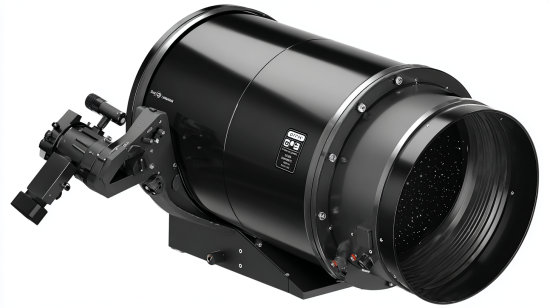
The Orion SkyQuest XT12g GoTo Dobsonian enters a demanding segment of the intermediate-to-advanced telescope market armed with a specification sheet that consistently outpaces competing designs at equivalent price brackets. A 305mm (12″) parabolic primary mirror, dual-axis DC servo motor GoTo control with closed-loop optical encoder feedback, built-in Wi-Fi, and a 42,000-object onboard database combine into a package that manual Dobsonians cannot replicate and that equatorial GoTo platforms of equivalent aperture rarely match in affordability. Whether this is your first large-aperture instrument or a deliberate upgrade from a push-to Dobsonian, the specifications demand careful reading before purchase. At a fully assembled weight of 101.8 lbs and a price point of approximately KD 899 (around USD $1,599–$1,799 depending on retailer), the XT12g represents a significant investment in both money and physical commitment. This article dismantles every key specification layer by layer, benchmarks the XT12g against four competing instruments in the same observational tier, and maps the telescope’s performance envelope to help you determine whether its strengths align with your observing goals.
Popular Products in This Category
Before examining the XT12g’s full specification profile in detail, the table below provides a comparative snapshot of five of the most widely purchased telescopes in the GoTo-capable and large-aperture reflector segment. Each entry includes the instrument’s defining specifications, community rating, and current price range to establish a competitive baseline.

1. Orion SkyQuest XT12g GoTo Dobsonian
The primary subject of this guide. Features a 305mm f/4.9 parabolic primary mirror on low-thermal-expansion borosilicate glass, 94% enhanced aluminum mirror coatings, fully motorized dual-axis GoTo with closed-loop encoder feedback, a 42,000-object SynScan database, built-in Wi-Fi for SynScan Pro app control, a dual-speed 2″ Crayford focuser (11:1), and a comprehensive accessory kit including a 28mm DeepView 2″ eyepiece and 12.5mm illuminated Plossl. Assembled weight: 101.8 lbs. Requires external 12V DC power.
Rating: Advanced User Level — Diffraction-limited optics
Price Range: KD 899 / approx. USD $1,599–$1,799

2. Celestron StarSense Explore DX 130 Newtonian Reflector
A 130mm f/5 Newtonian featuring Celestron’s smartphone app-enabled StarSense technology, which maps the sky using the phone’s camera to eliminate traditional star alignment entirely. Ships with two eyepieces, a phone dock, and a height-adjustable aluminum tripod. Not motorized — relies on manual nudge-to-target guidance from the app overlay. Best suited to beginners and early-intermediate observers prioritizing ease of setup over aperture size.
Rating: ★★★★☆ (4.1/5, 1,400+ reviews on Amazon)
Price Range: From approx. USD $694 / AUD $694

3. Sky-Watcher Heritage 130P Tabletop Dobsonian
A 130mm f/5 Newtonian on a compact tabletop rocker-box base with an innovative collapsible truss tube that dramatically reduces storage and transport dimensions. Parabolic primary mirror; 1.25″ rack-and-pinion focuser. Fully manual push-to operation with no GoTo or tracking capability. Best positioned as a beginner-to-early-intermediate instrument where portability and low mass take precedence over aperture.
Rating: ★★★★☆ (4.4/5, 66+ reviews on Amazon)
Price Range: From approx. USD $493 / AUD $493

4. Celestron PowerSeeker 127EQ Reflector
A 127mm f/7.87 Newtonian on a manual equatorial mount — one of the globally best-selling entry-level reflectors. Includes a 20mm and 4mm eyepiece plus a 3× Barlow. No GoTo; no motorized tracking standard (an optional single-axis motor is compatible). Assembled weight is modest at approximately 7.5 kg, making it significantly more portable than large Dobsonian designs. Intended for beginners exploring equatorial mechanics.
Rating: ★★★★☆ (4.2/5, 8,800+ reviews on Amazon)
Price Range: From approx. USD $352 / AUD $352

5. Celestron 114LCM Computerized Telescope
A 114mm f/8.77 Newtonian on Celestron’s NexStar single-arm computerized alt-azimuth GoTo mount with a 4,000+ object database. The SkyAlign procedure requires only three bright objects for alignment, simplifying initialization for newcomers. Dual-axis motorized tracking standard. Battery-powered (8× AA), making it fieldable without an external power source. Suited to beginners taking a first step into computerized pointing without the size commitment of a large Dobsonian.
Rating: ★★★★☆ (4.1/5, 940+ reviews on Amazon)
Price Range: From approx. USD $718 / AUD $718
Optics: What a 305mm Primary Mirror Delivers
The XT12g’s 305mm primary mirror is the specification that defines every other performance parameter in this telescope. Light-gathering area scales with the square of aperture diameter, which means the XT12g collects roughly 5.5 times more light than a 130mm instrument and approximately 2.7 times more than a 200mm (8″) scope. In practical observing terms, this directly enables resolution of faint galaxy spiral arms, detection of low-surface-brightness nebula filaments, and clean splitting of double stars at sub-arcsecond separations that smaller instruments render as unresolvable blur.
The mirror is ground to a parabolic figure, not a spherical approximation. Parabolic primaries ensure that parallel rays arriving from infinity converge to a single diffraction-limited focal point without coma at the mirror level, which is the primary motivation for the extra grinding cost over a spherical surface. The substrate itself is low-thermal-expansion borosilicate glass — the same material class used in high-grade research optics. Lower thermal expansion means the mirror’s focal length shifts less as the optic cools from indoor to outdoor ambient temperature, reducing the frequency of refocusing during extended sessions.
Mirror coatings are specified as enhanced aluminum with a silicon dioxide (SiO₂) overcoat, achieving a stated 94% reflectivity. Standard bare aluminum reflectivity sits at approximately 88–89% across the visual band; the 94% specification represents a meaningful 5–6 percentage point increase in flux transmission per mirror surface, with additional benefit at shorter blue wavelengths where uncoated aluminum degrades most rapidly. The SiO₂ overcoat also provides a protective abrasion and oxidation barrier, extending coating life compared to bare aluminum finishes.
At f/4.9 with a 1,500mm focal length, the XT12g is a fast wide-field instrument. Paired with the included 28mm DeepView 2″ eyepiece (56° apparent field), the exit pupil is approximately 5.7mm — close to ideal for a fully dark-adapted eye — and the true field of view spans approximately 0.97°, sufficient to contain large Messier showpieces like M42 (Orion Nebula) or M31’s core within a single uninterrupted view. Stepping to the included 12.5mm Plossl yields 120× magnification, a useful working power for planetary and lunar surface detail.
The 0.38 arc-second Dawes Limit resolving power is achievable under steady atmospheric seeing above a dark-sky site. The limiting stellar magnitude of 15.1 encompasses thousands of NGC and IC objects, many Abell galaxy clusters, and faint Palomar globular clusters that remain invisible to sub-200mm telescopes. The secondary mirror obstruction of 70mm diameter represents 23% of the primary diameter and only 5% of the primary’s collecting area — both values well within the threshold where diffraction effects on planetary contrast become perceptible, and lower in percentage terms than most Schmidt-Cassegrain designs.
The GoTo System: Closed-Loop Architecture and 42,000 Objects
The fundamental differentiator between the XT12g and a conventional manual Dobsonian is its fully motorized, closed-loop GoTo drive system. Both axes — altitude (ALT) and azimuth (AZ) — are driven by DC servo motors with high-resolution optical encoders. The closed-loop architecture is the critical engineering distinction: unlike open-loop stepper-motor systems common in many computerized mounts, the XT12g’s encoders continuously report actual axis position back to the controller, not just the number of steps commanded. The practical result is that manual repositioning of the tube by hand, or an accidental bump during an observing session, does not cause the system to lose its GoTo alignment — the controller reads the updated encoder positions and recalculates its pointing model instantly.
The 42,000-object database stored in the SynScan hand controller encompasses the complete Messier catalog, the full NGC and IC catalogs, the Abell galaxy cluster catalog, multiple double and multiple star catalogs, and named objects extending to the 15.1-magnitude limiting depth of the primary mirror. Object selection is managed through a softly red-illuminated keypad, which is a deliberate design choice to preserve the observer’s night-adapted vision during extended sessions. The red illumination wavelength (~630nm) triggers minimal rod suppression compared to white or blue-white LED displays.
The two-star alignment procedure is the standard initialization method. Two bright alignment stars are selected from the controller’s internal list, each is centered in the eyepiece field using the included 12.5mm illuminated reticle Plossl, and the controller constructs a pointing model that accounts for polar tilt and any mechanical misalignments in the base. An alternative “Brightest Star” alignment mode allows the controller to infer alignment star identities automatically from the telescope’s approximate geographic coordinates, date, and local time. Tracking modes include Sidereal, Solar, and Lunar, enabling the XT12g to follow stars, the Sun (with an appropriate solar filter, sold separately), and the Moon at their respective angular drift rates without requiring continuous manual correction.
The Tour function automates the selection of the highest-quality observable targets for any given observing date, time, and location. This is particularly valuable for observers working under time pressure or unfamiliar with the full depth of the NGC target catalog. Available interface ports (RS-232 and Aux) on the base permit third-party planetarium software — including widely used applications such as Stellarium, Cartes du Ciel, and The Sky — to assume control of the GoTo system via a computer.
Wi-Fi Connectivity: SynScan Pro App
All current-production XT12g units ship with built-in Wi-Fi capability. The telescope generates its own wireless access point to which a smartphone or tablet can connect, then runs the free SynScan Pro app (iOS and Android) to replicate every function of the wired SynScan hand controller: alignment procedures, database browsing, manual axis slew, tracking rate adjustment, and Tour mode. The physical hand controller remains included in the box and functions identically for users who prefer a dedicated control device.
Wi-Fi control offers three practical field advantages. First, it eliminates the hand controller cable as a trip hazard and potential snag point during nighttime movements around the telescope. Second, it allows the observer to issue GoTo commands from a seated or comfortable position away from the eyepiece — particularly relevant when the optical tube points near zenith, where the XT12g’s eyepiece position rises to an awkward standing height. Third, a tablet’s larger screen simplifies object list navigation in low ambient light relative to the hand controller’s 4-line display.
The SynScan Pro app is intentionally not a full planetarium application — it does not render real-time star charts or sky overlays. It is a GoTo control interface and database navigator. The bundled Starry Night Special Edition software (distributed as a digital download code) fills the planetarium function on a Windows or macOS computer.
Mechanical Construction and Design
The XT12g optical tube is manufactured from steel and measures 58.3 inches (148.1 cm) in length, with a stated weight of 48.9 lbs. At this mass, two-person handling during loading and transport is advisable, particularly when maneuvering into or out of a vehicle. The tube integrates into the Dobsonian base via a dovetail trunnion mechanism secured by a single hand knob, reducing assembly from the multi-bolt process required by some competing designs to a matter of seconds.
The rocker box base is constructed from wood — the traditional Dobsonian material, chosen for its favorable stiffness-to-weight ratio and inherent vibration-damping properties that metal bases do not replicate. The base weighs 52.9 lbs, resulting in a total assembled mass of 101.8 lbs. Three flush-mounted handles on the base’s front and side panels provide secure grip points during transport; three plastic feet offer stable contact on uneven ground surfaces. The altitude axis uses ball bearings and the azimuth axis uses thrust needle bearings — both selected to minimize friction and backlash under the sustained rotational loads imposed by the servo drive motors.
The open mirror cell design promotes efficient thermal equalization of the 305mm primary with ambient air temperature. Thermal equilibration is important because a mirror that is warmer than the surrounding air creates a local convection column in the optical path that degrades image resolution. The XT12g mirror cell includes threaded holes to accept an optional cooling accelerator fan (sold separately), which can compress equilibration time from a typical 30–45 minutes to approximately 10–20 minutes in cold observing conditions. The 12.5mm center-marking on the primary mirror simplifies the collimation process by providing a clear visual reference when using the included collimation cap.
The 2″ dual-speed Crayford focuser is one of the XT12g’s most practically significant mechanical specifications. Crayford mechanisms eliminate the backlash inherent in standard rack-and-pinion designs because they rely on bearing friction against a smooth drawtube rather than meshing gear teeth. This produces backlash-free travel even under the weight of heavy 2″ eyepieces. The 11:1 fine-focus ratio means that one full turn of the fine-focus knob moves the drawtube at one-eleventh the rate of the coarse knob — sufficient resolution to achieve diffraction-limited focus at the XT12g’s highest practical magnification of 300×. A 1.25″ step-down adapter is included, providing compatibility with the much wider library of 1.25″ eyepieces available on the market.
Accessories: What Is Included
The XT12g ships with a sufficiently complete accessory package to begin substantive observing immediately without any supplementary purchases. The 28mm DeepView 2″ eyepiece yields 54× magnification with a 56° apparent field of view and a generous 20mm of eye relief — comfortable for eyeglass wearers during extended sessions. Its multi-coated optics minimize internal reflections and improve transmission compared to uncoated alternatives. The 12.5mm illuminated Plossl (1.25″) delivers 120× magnification and features an LED-illuminated double crossline reticle with independently adjustable illumination brightness and reticle focus — purpose-engineered for the precision star centering required during GoTo alignment star acquisition.
The EZ Finder II reflex sight is a zero-power illuminated red dot finder. It projects a small red point onto a flat glass window angled toward the sky, allowing the observer to aim the telescope at a known bright alignment star or general sky region before handing pointing control to the GoTo system. The eyepiece rack, secured to the telescope base, accommodates one 2″ and three 1.25″ eyepieces within arm’s reach during a session. Additional included items are: a quick collimation cap for optical axis verification, a hand controller holster with mounting hardware, a complete set of hex keys for assembly, a tube-to-base securing knob, and all base assembly hardware. A 12V DC power cable with automotive cigarette lighter-style plug is included; the telescope requires an external 12V DC supply at a minimum 2A current (tip positive), from a portable field battery or AC adapter — neither of which is included in the box.
Power Requirements and Field Portability
The XT12g has no internal battery capability. It is entirely dependent on an external 12V DC power supply for all motorized functions. Compatible sources include dedicated astronomy field batteries (such as lithium-based power tanks available from multiple manufacturers), portable power stations with a 12V DC output, or a standard automotive 12V battery accessed via the included cigarette lighter cable. The minimum 2A current draw is low enough that most consumer-grade power banks with a 12V barrel output will sustain multiple hours of operation on a single charge.
For transport, the telescope separates into two main assemblies: the optical tube at 48.9 lbs and the rocker box base at 52.9 lbs. No single component exceeds 53 lbs, which is within the safe lifting capacity of most adults, though the tube’s length of nearly five feet makes it unwieldy for solo maneuvering. A vehicle with substantial cargo area — an SUV, estate car, or van — is the practical transport requirement. The XT12g is not classified as a grab-and-go instrument by any reasonable definition; it is best suited to observers with a dedicated garden or patio setup location, or those willing to make a deliberate car-to-field transport effort for access to dark skies.
Who Should Consider the XT12g
The XT12g is explicitly rated by Orion as an advanced-user instrument. Its primary observing strength is faint deep-sky objects — low-surface-brightness galaxies, diffuse nebulae, faint globular clusters, and dim planetary nebulae — where the 305mm aperture’s light-collection advantage is most decisive over smaller instruments. For astrophotography, the mount’s alt-azimuth geometry introduces field rotation that limits practical exposures to short lunar and planetary captures; long-exposure deep-sky photography requires a field de-rotator peripheral not included or offered as an add-on for this product.
Observers prioritizing pure visual deep-sky performance per dollar will find the XT12g extremely difficult to surpass at its price bracket. A 12″ Schmidt-Cassegrain or Ritchey-Chrétien of comparable optical quality demands a substantially higher budget. A 12″ manual Dobsonian costs less but sacrifices all automated pointing and tracking convenience. The XT12g occupies the deliberate intersection of these two market positions, delivering automated GoTo object acquisition, motorized tracking across three celestial rates, and 305mm aperture optics at a price more closely aligned with manual large-aperture designs than with GoTo-equipped equatorial platforms of equivalent aperture. For the intermediate-to-advanced observer whose observing sessions are driven by visual deep-sky exploration and who values the time savings of automated object finding over the complexity of a polar-aligned equatorial system, the Orion SkyQuest XT12g GoTo Dobsonian presents a well-resolved and specification-complete argument.