
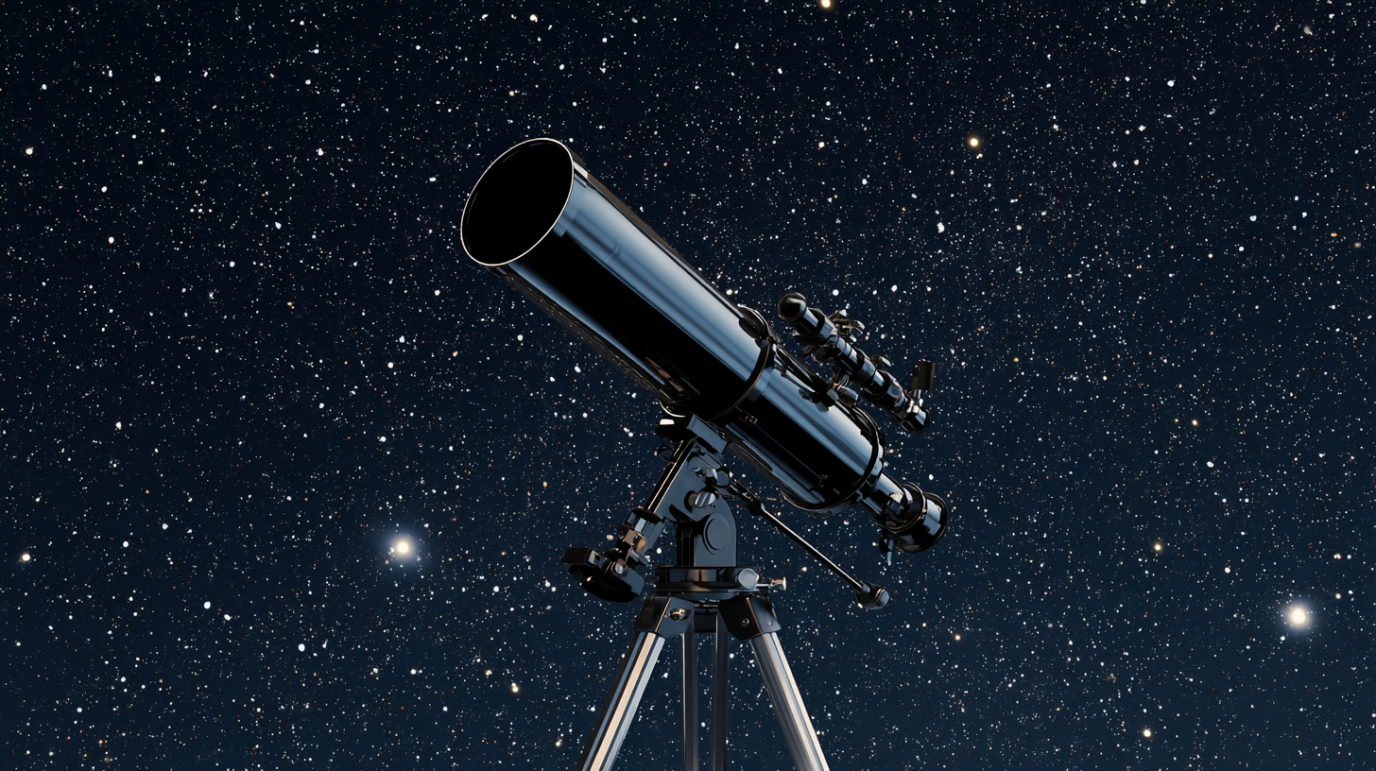
The Night Sky Is Trending — and Orion Just Dropped the Right Scope for the Moment
Space is officially having its cultural moment. Astrophotography feeds are dominating social media, dark-sky road trips are showing up on bucket lists, and a new generation of curious stargazers — from eight-year-olds to busy professionals — is looking up at the night sky with fresh eyes and a serious question: where do I even start? The answer the astronomy community keeps coming back to, season after season, is the Orion SpaceProbe 3 Altazimuth Reflector Telescope. Lightweight. Capable. Beautifully approachable. This scope isn’t just a product — it’s a collab between Orion’s decades of optical engineering credibility and every beginner who’s ever dreamed of seeing Saturn’s rings with their own eyes. Built around a 76mm (3-inch) glass primary mirror, mounted on an intuitive altazimuth mount, and equipped with an EZ Finder II reflex sight that makes navigating the sky feel effortless, the SpaceProbe 3 lowers the barrier to entry without cheapening the experience. Whether you’re gifting it to a kid who can’t stop talking about black holes, or treating yourself to a weekend hobby that actually delivers, this scope is the move. It’s portable enough for spontaneous dark-sky sessions, powerful enough to show you Jupiter’s moons and Saturn’s rings, and simple enough that your first night out is rewarding — not frustrating. Let’s unpack everything this iconic beginner telescope brings to the table, and along the way, explore the five most popular telescopes riding the current wave of astronomical enthusiasm.
🌟 Trending Now: The 5 Most Popular Beginner Telescopes Right Now
Before we go deep on the SpaceProbe 3, here’s the community-approved shortlist of the most talked-about beginner telescopes making their rounds. These are the trend-forward picks the astronomy crowd keeps recommending — and each one brings something unique to the collab.
1. Orion SpaceProbe 3 Altazimuth Reflector Telescope

The Heritage Drop That Keeps Delivering
The headliner. Built around a 76mm Newtonian reflector optical tube with a 700mm focal length and f/9.2 focal ratio, the SpaceProbe 3 ships with two 1.25-inch Explorer II eyepieces (25mm for 28x magnification and 10mm for 70x magnification), an EZ Finder II reflex sight for easy sky navigation, a rack-and-pinion focuser, a collimation cap, an aluminum adjustable tripod with accessory tray, and Starry Night Special Edition astronomy software. Fully assembled weight: just 8.4 lbs. Optical quality: diffraction-limited. Manufacturer: Optronic Technologies, Inc. This is a serious piece of optical kit dressed in a beginner-friendly package.
⭐ Rating: 4.2 out of 5 stars (63 global ratings)
💰 Price Range: ~$89.99 (new) | ~$175.00 (used, eBay)
2. Celestron StarSense Explorer LT 114AZ Smartphone App-Enabled Telescope

The Tech-Forward Collab for the App-First Generation
Celestron bridges the gap between telescope optics and smartphone intelligence with this 114mm aperture Newtonian reflector. The StarSense Explorer app uses your phone’s camera to map the sky above you in real time and guide you directly to objects — no star chart, no guesswork. For tech-savvy beginners who want their gear to integrate with their digital lifestyle, this is the obvious entry point.
⭐ Rating: 4.1 out of 5 stars (1,425 ratings)
💰 Price Range: From ₹21,999 (~$265 approx.)
3. Celestron AstroMaster 130 EQ Telescope

The Power-Up Pick for Serious Starters
The community’s go-to recommendation for beginners who are ready to skip past casual and commit to structured sky tracking, the AstroMaster 130 EQ features a 130mm aperture and an equatorial mount for precision object tracking. With over 3,300 ratings, this is statistically the most widely trusted telescope at this price tier. A true collab between accessibility and genuine optical power.
⭐ Rating: 4.0 out of 5 stars (3,372 ratings)
💰 Price Range: From ₹22,499 (~$270 approx.)
4. Pie Matrix Pegasus 76700 Newtonian Reflector Telescope

The Budget Statement Piece
Punching above its price point with 76mm aperture optics, 235x ultra HD zoom, fully coated glass, and an altazimuth mount, the Pegasus 76700 is a strong value drop for anyone who wants to see the Moon, Saturn’s rings, and planetary detail without stretching their budget past its limit. A frequently recommended alternative for families who want to test the waters before committing to a larger investment.
⭐ Rating: 4.0 out of 5 stars (274 ratings)
💰 Price Range: From ₹10,878 (~$130 approx.)
5. SSEA Telescope Mod 70076 Reflector Astronomical Telescope

The Complete-Package Drop for Absolute Beginners
The SSEA 70076 is a 70mm aperture reflector that ships with a full-size stand and a carry bag — making it one of the most complete out-of-box experiences at this price level. Multi-power enhanced optics deliver HD views of the Moon and brighter planets, and the included bag makes portability genuinely practical. A reliable community pick for anyone wanting everything in one box.
⭐ Rating: 4.2 out of 5 stars (326 ratings)
💰 Price Range: From ₹9,499 (~$115 approx.)
With the lineup set, let’s dive fully into the star of the show: the Orion SpaceProbe 3 Altazimuth Reflector Telescope.
Why the Orion SpaceProbe 3 Is the Collab Nobody Outgrows
The beginner telescope market is crowded with products that overpromise and underdeliver — cheap plastic builds, mediocre optics dressed in flashy packaging, and “toy scopes” that produce blurry, frustrating views that kill curiosity rather than inspire it. The Orion SpaceProbe 3 was engineered with a fundamentally different philosophy: give beginners real optical performance inside a package that doesn’t require an engineering degree to operate.
Orion, manufactured by Optronic Technologies, Inc., is one of the most respected names in amateur astronomy. Their instruments have graced the backyards, balconies, and dark-sky retreats of millions of stargazers worldwide. The SpaceProbe 3 represents Orion’s commitment to making that quality accessible at every level. Its 4.2-star rating across 63 global reviews, with 60% of reviewers awarding a full five stars, isn’t a fluke — it’s the consistent result of a telescope that delivers on its promise, night after night.
The Optical Core: 76mm Primary Mirror and Newtonian Engineering
The entire optical experience of the SpaceProbe 3 begins with its 76mm (3-inch) diameter primary mirror — the component that collects and focuses the faint light of distant celestial objects. The mirror is crafted from soda-lime plate glass, ground to a spherical curve, and coated with a dual-layer finish of aluminum and silicon dioxide. That coating combination is significant: aluminum provides the high reflectivity, while the silicon dioxide overcoat acts as a hard protective layer that keeps the mirror performing at its best over years of use.
The telescope follows the classic Newtonian reflector design conceived by Isaac Newton himself. Light enters the open front of the tube, strikes the curved primary mirror, and is reflected toward a smaller flat secondary mirror suspended near the front of the tube. The secondary mirror redirects the converging light out through the focuser on the side of the tube and into the eyepiece. The result is a compact, efficient optical system that delivers excellent contrast and brightness per dollar invested — qualities that make Newtonian reflectors the perennial favorite of value-conscious astronomers.
The focal length of 700mm and focal ratio of f/9.2 place the SpaceProbe 3 firmly in the longer, slower focal ratio camp — a characteristic that translates to sharp, high-contrast planetary and lunar views with the included eyepieces. The optics are certified diffraction-limited, meaning the only constraint on image quality is the fundamental physics of light itself, not any manufacturing imperfection in the glass or mirror. This is the benchmark of quality optical instruments and a genuine distinction from cheaper competitors that cannot make this claim.
With a limiting stellar magnitude of 12.1, the SpaceProbe 3 can reveal stars more than a thousand times fainter than the naked eye can see. Its resolving power of 1.52 arc-seconds allows it to separate closely paired double stars and reveal fine surface texture on the Moon and planets. The lowest useful magnification is 18x and the highest useful magnification is 95x, while the theoretical maximum magnification reaches 152x — a range that makes this scope genuinely versatile for an entry-level instrument.
The Altazimuth Mount: The Collab Between Simplicity and Stability
The mount is often the unsung hero (or hidden villain) of any telescope experience, and the SpaceProbe 3 makes an excellent choice here. Its altazimuth mount is the most intuitive design in astronomy: move the telescope up or down to adjust altitude, move it left or right to adjust azimuth. That’s the entire learning curve. No polar alignment, no declination coordinates, no mental gymnastics — just point and look.
The mount rides on an adjustable-height aluminum tripod that accommodates observers of all ages and heights. The tripod legs lock securely at any extension, and the overall assembly is stable enough to hold the telescope steady during high-magnification planetary observing — a frequent failure point of cheaper scopes with wobbly, vibration-prone tripods.
What elevates the SpaceProbe 3’s mount above simple alt-az basics is the inclusion of an altitude micro-motion control rod and thumbwheel. At higher magnifications, even the slightest jarring will send an object drifting out of the field of view. The micro-motion thumbwheel lets you make fine, precise altitude adjustments with your fingertip, keeping targets centered as the Earth’s rotation carries them across the sky. This feature alone is a significant quality-of-life upgrade that users consistently appreciate in reviews.
The mount also features setting circles — graduated rings that let you use a celestial object’s known coordinates (right ascension and declination) to locate it by dialing in the numbers. As beginners grow into more experienced observers, this capability opens the door to more systematic sky exploration. It’s a feature that proves the SpaceProbe 3 was designed not just for first nights, but for many nights to come.
The EZ Finder II: Your Night Sky GPS
Ask any experienced amateur astronomer about their early struggles, and the answer is almost always the same: finding objects was the hard part. The night sky is vast, telescope fields of view are narrow, and pointing a scope at the right spot without guidance feels impossible at first.
The EZ Finder II reflex sight included with the SpaceProbe 3 is a beautifully simple solution. It mounts on the optical tube and projects a small red dot onto a transparent lens. When you look through the finder with both eyes open, you see the red dot overlaid on the actual sky. Once aligned with the telescope’s main optic (a quick, one-time process), the workflow is as simple as it gets: place the red dot on the object you want to see, look through the eyepiece, and it’s there.
No star charts. No hunting. No frustration. The EZ Finder II dramatically reduces the learning curve of telescope operation and ensures that first sessions are rewarding discoveries rather than discouraging failures. It uses a single lithium-ion battery (included) and has an adjustable brightness setting for different sky conditions.
Two Eyepieces, Two Experiences
The SpaceProbe 3 ships with two 1.25-inch Explorer II eyepieces — the industry-standard barrel size that is compatible with virtually every aftermarket eyepiece, Barlow lens, and accessory on the market. This future-proofing means that as you grow as an observer and start shopping for additional optical accessories, your investment in the SpaceProbe 3 continues to pay off.
The 25mm eyepiece delivers 28x magnification and a wide field of view, making it the ideal first eyepiece to reach for at any session. At this power, the full disk of the Moon fills the field beautifully — crater walls, mountain ranges, and the ghostly grey plains of the lunar maria are rendered with striking clarity and depth. Open star clusters like the Pleiades and the Double Cluster in Perseus resolve into individual stars scattered across the field like scattered diamonds. This is your wide-field, exploratory eyepiece — the one you use to sweep the Milky Way and survey large regions of sky.
The 10mm eyepiece pushes the magnification to 70x, bringing you close enough to the sky’s showpieces that every session becomes a highlight reel. At 70x, Saturn’s rings are clearly separated from the planet’s disk and visibly inclined — a view that has stopped the hearts of every first-time observer who encounters it. Jupiter’s cloud bands become faintly visible under steady atmospheric conditions, and the four Galilean moons — Io, Europa, Ganymede, and Callisto — appear as bright points of light arranged along Jupiter’s equator, their positions shifting from night to night in a real-time demonstration of orbital mechanics.
For those ready to push further, pairing either eyepiece with a quality 2x Barlow lens (sold separately) effectively doubles the magnification range, reaching up to the 95x useful maximum. The highest theoretical magnification of 152x is achievable under excellent seeing conditions with a suitable eyepiece.
Everything in the Box
The SpaceProbe 3 ships as a complete, ready-to-observe kit — nothing extra required for your first successful night under the stars. The package includes the Orion Reflector optical tube assembly, the 25mm and 10mm Explorer II eyepieces, the altazimuth yoke telescope mount, aluminum tripod legs with leg lock knobs, the EZ Finder II finder scope and its bracket, a dust cap for the primary mirror, a reflector collimation cap for maintaining mirror alignment, an altitude micro-motion control rod and thumbwheel, the tripod accessory tray, all necessary hardware (tripod attachment screws, wing nuts, washers, accessory tray wing screws, yoke knobs), and the Starry Night Special Edition planetarium software. Starry Night is a fully featured star-mapping application that lets you explore the sky virtually, plan your observing sessions, and identify what you’re seeing — an invaluable companion for beginners finding their bearings in the cosmos.
Who This Scope Was Made For
The Orion SpaceProbe 3 is designed for beginners across the full age spectrum. It is the right first telescope for a child aged 10 and up who has developed a genuine curiosity about space. It’s the right telescope for a parent who wants a shared family activity that isn’t a screen. It’s the right telescope for a college student wanting a low-commitment entry into a scientifically rich hobby. And it’s the right telescope for anyone who wants something genuinely portable — at just 8.4 lbs fully assembled, the SpaceProbe 3 fits in the trunk of any car and can be set up at a dark-sky site in under ten minutes.
One important note for parents gifting this to younger children: because the SpaceProbe 3 is a Newtonian reflector, it will occasionally need collimation — a simple alignment of its primary and secondary mirrors. This is a straightforward process that takes five minutes once learned, and the included collimation cap guides you through it. Orion also provides excellent video tutorials online. Adult involvement in this aspect of maintenance is recommended for observers under twelve.
What the Community Is Saying
The SpaceProbe 3’s 4.2-star average across 63 global reviews tells a compelling story. Among verified purchasers, a practicing astrophysicist praised the altazimuth mount’s ease of use, noting they specifically bought it to keep in their car for spontaneous observing sessions and found the image quality thoroughly satisfying. A beginner moving on from binoculars described the scope as the perfect stepping stone — intuitive to learn, rewarding to use, and far exceeding their expectations for the price. Multiple reviewers cite the lunar views as a standout highlight, describing sharp, detailed crater fields that delivered genuine awe on the first night out. Jupiter’s Galilean moons are consistently called out as a “moment” — the specific view that converts casual interest into a real hobby.
The SpaceProbe 3’s build quality also draws consistent praise. The steel optical tube, aluminum tripod, and solid yoke mount feel well-made and durable — a reassuring contrast to toy-grade alternatives that flex, wobble, and disappoint.
The Verdict: A Collab Worth Every Star
In a market where beginner telescopes either fail to deliver real performance or overwhelm new users with complexity, the Orion SpaceProbe 3 Altazimuth Reflector Telescope finds precisely the right balance. It respects the intelligence of its users — delivering genuinely diffraction-limited optics, thoughtful accessories, and a mount design that feels good to use from minute one. At the same time, it never punishes beginners with unnecessary complications.
This is the telescope that turns one clear night into a lifelong pursuit. The view of Saturn’s rings through the 10mm eyepiece. The crater fields sweeping past during a slow lunar pan. Jupiter’s moons arranged in a line, different from yesterday, different again tomorrow. These are the experiences the SpaceProbe 3 was built to deliver — and it delivers them consistently, reliably, and with a polish that makes every session feel like a worthy collab between you and the cosmos.
The Orion SpaceProbe 3 isn’t just a beginner telescope. It’s the beginning of something much bigger.