
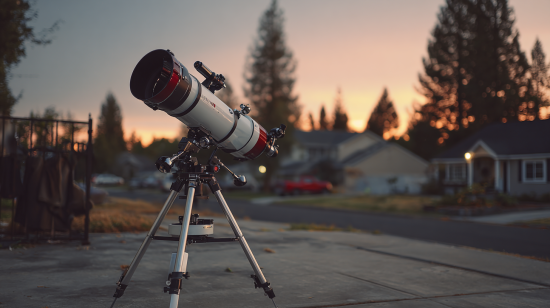
I’ll be honest with you — I’ve owned a lot of telescopes. Some collected dust in the corner after the novelty wore off. Some were so frustrating to set up that I’d skip clear nights rather than deal with them. And some turned out to be toys dressed up in scientific packaging, leaving me squinting at a blurry smear of light where Jupiter was supposed to be. But the Orion StarBlast 4.5 Equatorial Reflector Telescope is none of those things. After years of using it, recommending it, and watching first-time stargazers fall genuinely in love with the night sky through its eyepiece, I can say with complete confidence that this compact little reflector punches well above its weight class. Here is everything I’ve learned — the good, the practical, and the candid truth about long-term ownership.
Five Popular Entry-Level Reflector Telescopes Worth Knowing
Before going deep on the StarBlast 4.5 EQ specifically, here’s a quick look at five of the most popular beginner-to-intermediate reflector telescopes available today — including the featured product — so you can put its value into proper context.

1. Orion StarBlast 4.5 EQ Reflector Telescope
The star of this article, and for good reason. The StarBlast 4.5 EQ pairs a wide-field 4.5-inch parabolic mirror with a sturdy EQ-1 equatorial mount and includes an EZ Finder II reflex sight. It is beloved by beginners and experienced observers alike for its portability and bright, impressively wide-field views right out of the box.
⭐ Rating: 4.5 / 5
💰 Price Range: $105 – $330 (depending on condition and seller)

2. Orion StarBlast II 4.5 EQ Reflector Telescope
The spiritual successor to our featured scope, the StarBlast II upgrades the eyepiece lineup to 25mm and 10mm Sirius Plossl eyepieces, delivering 18x and 45x magnification out of the box, and also bundles a MoonMap 260. It rides the same EQ-1 equatorial mount platform and retains the excellent parabolic optics of the original — a great choice if you want a slightly more refined first-night experience.
⭐ Rating: 4.6 / 5
💰 Price Range: $199 – $260

3. Celestron AstroMaster 130EQ Newtonian Reflector
Celestron’s AstroMaster 130EQ offers a slightly larger 130mm aperture mounted on an EQ-2 equatorial mount. It is a compelling step up in light-gathering power for those who want to push further into deep-sky territory. The mount is more robust, though the scope itself is noticeably heavier and less portable than the StarBlast.
⭐ Rating: 4.3 / 5
💰 Price Range: $279 – $360

4. Explore Scientific FirstLight N114mm Newtonian with EXOS Nano EQ3
The Explore Scientific FirstLight N114mm combines a 114mm Newtonian optical tube with the EXOS Nano EQ3 equatorial mount — a mount widely praised for its precision and smooth movement. This is a strong pick for someone who prioritizes mount quality from day one, though it comes at a higher price point than most entry-level options.
⭐ Rating: 4.4 / 5
💰 Price Range: $249 – $280

5. Celestron PowerSeeker 114EQ Newtonian Reflector
The Celestron PowerSeeker 114EQ is often the first telescope many beginners consider, thanks to its low price and wide availability. It offers 114mm of aperture on an equatorial mount, includes two eyepieces and a 3x Barlow lens. However, long-term users often find the mount less precise and the included accessories limiting compared to the Orion lineup.
⭐ Rating: 3.9 / 5
💰 Price Range: $120 – $170
Now that you have a sense of the landscape, let’s get into the full story of the Orion StarBlast 4.5 EQ — the telescope I keep reaching for, year after year.
Why I Keep Coming Back to the StarBlast 4.5 EQ
There’s a version of telescope shopping that sounds good on paper and fails in practice. You buy something ambitious — a big, complicated mount, a long focal length tube, an automated computerized system — and then the setup friction quietly defeats you. Nights that should be relaxing become chores. I’ve been there. The Orion StarBlast 4.5 EQ solved that problem for me.
Its 4.5-inch (114mm) parabolic mirror and f/4.0 focal ratio make it one of the fastest, most forgiving wide-field reflectors available at this price. Fast focal ratios mean wider fields of view, brighter images at any given magnification, and less hunting around the sky looking for your target. On more than one occasion, I’ve pointed this scope at the Orion Nebula, the Pleiades, or the Beehive Cluster and immediately thought, “Oh, there it is.” That instinctive sense of ease is not always the experience with entry-level equipment.
The Optics: Parabolic, Not Spherical — And It Matters
Not all beginner reflectors are created equal. One of the most important things I want to be transparent about: the StarBlast 4.5 uses a parabolic mirror, not the spherical mirror found in many budget reflectors. This distinction is genuinely significant.
A spherical mirror introduces an optical aberration called spherical aberration — stars near the edge of the field appear as smeared, comet-like blobs, and image sharpness suffers across the board. A parabolic mirror, the kind used in professional-grade observatories and in this telescope, focuses all incoming light to a single precise focal point, producing what optical engineers call diffraction-limited quality. In plain English: stars look like sharp, clean points rather than fuzzy smears.
The mirror itself is coated with aluminum and silicon dioxide, a combination that balances high reflectivity with long-term durability. After years of regular use, I’ve never needed to recoat or replace the mirror. It’s held up beautifully under conditions ranging from humid summer nights to cold winter air.
The 450mm focal length is short by reflector standards, and that’s entirely intentional. Shorter focal lengths produce wider, brighter views — perfect for sweeping across the Milky Way’s star fields or framing a large object like the Andromeda Galaxy in a single eyepiece view. The trade-off is that you’ll want to add a higher-power eyepiece down the line if you want to push detail on the planets, but the included eyepieces handle that reasonably well as a starting point.
What Comes in the Box
One of my recurring complaints with beginner telescopes is that manufacturers bundle eyepieces so mediocre they seem almost designed to disappoint. The StarBlast 4.5 EQ takes a different approach with the included Orion Expanse eyepieces — a 15mm and a 6mm — each featuring a wide 66° apparent field of view. That breadth is notably generous for included accessories at this price. Most bundled eyepieces offer fields of 50° or less, which can make stargazing feel like peering through a keyhole. The Expanse eyepieces feel more like proper windows.
The 15mm Expanse delivers 30x magnification, making it the right starting point for locating targets and getting oriented in the sky. The 6mm Expanse delivers 75x magnification, ideal for closer inspection of the Moon’s craters, Jupiter’s cloud bands, and Saturn’s ring system. Both eyepieces seat in the standard 1.25″ rack-and-pinion focuser, which operates smoothly and accepts any third-party 1.25″ eyepiece you might want to add later.
The full package also includes:
- The EZ Finder II reflex sight, which projects a small red dot onto a viewing window, making it remarkably simple to aim the telescope without fussing with a traditional finder scope. Starhopping around the sky becomes genuinely intuitive with this tool.
- A collimation cap for maintaining optical alignment between observing sessions.
- Slow-motion control cables for smooth tracking via the EQ-1 mount.
- An aluminum adjustable-height tripod that spans from 32.5 inches to 54.75 inches in height.
- A 4.8 lb. counterweight to balance the optical tube on the mount.
- Starry Night special edition software for planning and learning your way around the sky.
That is a complete, ready-to-observe kit. Orion didn’t cut corners on the accessories here, and it shows.
The EQ-1 Mount: Your Best Friend on Clear Nights
I want to spend meaningful time on the EQ-1 equatorial mount, because I think it is consistently the most underappreciated part of this package. Equatorial mounts are fundamentally different from the simple alt-azimuth mounts that come with most entry-level scopes. Rather than moving up-down and left-right independently, an equatorial mount is aligned with Earth’s rotational axis, meaning it can track celestial objects with a single, smooth movement along one axis.
In practice, this means that once you’ve centered Saturn in the eyepiece, you only need to nudge one slow-motion cable to keep it there as the Earth rotates. On an alt-azimuth mount, you’d need to constantly adjust both axes simultaneously — a subtle but persistent frustration that first-time buyers don’t always anticipate until they’re standing outside in the dark, losing their target every thirty seconds.
The EQ-1 is not a heavy-duty research mount, and I won’t pretend otherwise. It uses friction bearings and features setting circles on both right ascension and declination axes, allowing for basic coordinate-based navigation once you understand the equatorial coordinate system. It can also accept an optional clock-drive motor for hands-free automatic tracking once you’ve centered your target. The latitude adjustment range spans 14° to 70°, making it suitable for use virtually anywhere in the Northern Hemisphere and well into the Southern.
Setting up the mount correctly the first time requires a brief learning period — specifically, polar alignment, where you orient the mount’s polar axis toward the celestial pole. Orion’s included manual walks through the process clearly, and after a handful of sessions, it becomes second nature, taking under five minutes from start to observing.
The counterweight shaft is 8 inches long, and the included 4.8 lb. counterweight does a reliable job of balancing the optical tube. The fully assembled telescope weighs 20.7 lbs., with the optical tube alone weighing just 4 lbs. That matters enormously for portability — the tube is light enough that I’ve regularly transported it in the backseat of a car for a drive out to a dark field, without needing a second person or a dedicated vehicle.
What You Can Actually See Through This Telescope
Let’s talk about what genuinely matters: the night sky itself.
With a limiting stellar magnitude of 12.9, the StarBlast 4.5 EQ reveals stars far dimmer than the naked eye can perceive. Its resolving power of 1.02 arc-seconds is sharp enough to cleanly split most double stars and reveal fine structure on the Moon and planets.
The Moon is an absolute showstopper through this telescope. Craters, mountain ranges, and valley systems snap into crisp detail at 30x, and become spectacular at 75x. On nights of steady atmospheric seeing, I’ve been genuinely arrested staring at the terminator — the boundary between the Moon’s lit and unlit halves — where low-angle shadows transform every crater and ridge into a dramatic three-dimensional landscape.
Planets are visible and genuinely rewarding. Saturn’s rings are clearly separated from the planetary disk, and Cassini’s Division within the rings can be glimpsed on steady nights. Jupiter’s equatorial cloud bands and four Galilean moons are easily visible, and Mars near opposition shows its reddish disk clearly, with polar ice caps sometimes detectable. These are the moments that turn casual interest into lifelong passion.
Deep-sky objects are where the fast f/4 optics really come into their own. Star clusters like the Pleiades, Hyades, and Beehive fill the wide field magnificently. The Orion Nebula (M42) glows with visible structure. The Andromeda Galaxy (M31) extends clearly across the field as a softly glowing ellipse. From a dark site away from city light pollution, fainter nebulae and clusters become genuinely compelling targets that you can explore for entire evenings. The telescope’s theoretical maximum useful magnification of 228x is rarely needed for visual observing, but knowing that ceiling exists means there’s room to grow your eyepiece collection over time without immediately outgrowing the scope.
For basic astrophotography, the StarBlast 4.5 EQ is rated as capable of lunar and planetary imaging. It won’t compete with dedicated astroimaging platforms, but attaching a smartphone adapter or a basic planetary camera to the focuser produces impressive images of the Moon and bright planets that are deeply satisfying to review afterward.
Honest Long-Term Ownership Notes
After years with this telescope, here’s what I want to be straightforwardly candid about.
The rack-and-pinion focuser works reliably, but it is not a precision Crayford design. Heavier eyepieces can cause slight tube sag if the drawtube lock isn’t firmly tightened. It’s a minor inconvenience, not a dealbreaker, and the solution is simply developing the habit of snugging that lock before swapping eyepieces.
Collimation — the process of aligning the primary and secondary mirrors — is something you’ll need to check periodically, particularly after transporting the telescope. The included collimation cap makes the process manageable, and properly aligned optics produce a visible, rewarding improvement in image sharpness. Plan on a brief collimation check every few sessions.
The EQ-1 mount can feel slightly wobbly at very high magnifications if there is wind or if the tripod legs are fully extended. Keeping the legs at a medium-low height and ensuring the counterweight is properly positioned keeps vibration to a minimum.
The telescope carries a one-year warranty from Orion, which covers manufacturing defects. Orion’s customer support has generally been considered knowledgeable and responsive when it comes to their own products.
Who Is This Telescope For?
I’d wholeheartedly recommend the Orion StarBlast 4.5 EQ to a few specific kinds of people.
It’s ideal for the curious first-time buyer who wants a telescope that will genuinely reward their interest rather than frustrate it into abandonment. The wide-field optics, red-dot finder, and included Starry Night software make the initial learning curve manageable and enjoyable.
It’s an equally strong choice for the experienced observer who wants a grab-and-go companion scope — something light enough to take camping, to a dark-sky site, or out to the backyard on a spontaneous clear evening, without the ceremony of deploying a large system.
And it’s a fantastic option for families with children, since the fast, wide-field views make it easy for kids and adults alike to locate and enjoy objects without protracted, discouraging searches through a narrow eyepiece.
What it is not: a dedicated deep-sky imaging platform or a planetary specialist. If your primary goal is long-exposure astrophotography or maximum resolving power on planetary surfaces, you’ll eventually want dedicated astroimaging equipment or a longer focal length system. But for visual observing and casual lunar and planetary photography, this is a genuinely capable, honest, and deeply enjoyable instrument.
Final Thoughts
Telescopes come and go, but some instruments earn a permanent place in your observing life. The Orion StarBlast 4.5 Equatorial Reflector Telescope has earned that place for me. Its combination of parabolic optics, fast f/4 focal ratio, wide-field Expanse eyepieces, EZ Finder II reflex sight, and EQ-1 equatorial tracking mount forms a package that is thoughtfully assembled, genuinely pleasurable to use, and honest in what it delivers night after night.
If you’re standing at the beginning of your astronomy journey, this telescope will not let you down. If you’re a seasoned stargazer looking for a portable companion scope, you’ll find it keeps pace with you admirably. The night sky is vast, and the StarBlast 4.5 EQ gives you a reliable, beautiful, long-lasting window into it — one clear night at a time.
Clear skies.